Old, Faded Stamped Concrete? 3 Ways to Bring It Back to Life
Is your stamped patio, driveway, or pool deck past its prime? Depending on when it went in, there are two common reasons why.


Stamped concrete was especially popular during the mid-2000s, so if yours went in around 2004 to 2007, it’s now old enough that it probably needs more than a quick clean. If yours was installed during the 2020-2021 pandemic-driven home improvement boom, you’re due for a wash and a fresh coat of sealer.
Either way, your concrete is likely fine. What’s changed is the color, the sheen, or both. Here are three ways to fix it, from a light touch-up to a full recolor. Read on to find out which one is best for you.
What’s Actually Wrong With Your Stamped Concrete?
Before you assume you need any kind of fix, start with the basics.
First, clean it. What looks like fading may just be dirt and grime, not a color problem at all.
Then check if it’s still sealed:
“Splash some water on it. If your stamped concrete looks better wet than dry, the color’s still there, it’s the sealer that’s gone.”
– Johnny D’Introno, Solomon Colors trainer
Concrete color doesn’t actually fade the way you might think. What’s really happening is that on older or unsealed slabs the top layer, called the cream, wears from years of traffic and weather. That layer carries the secondary color, from the color hardener or antiquing agent applied at install. So as the cream wears away, that secondary color goes with it, and more of the base integral color shows through.
Still think it needs a facelift once it’s clean and you’ve checked the sealer? Match what you’re seeing to one of these three fixes:
- Color’s fine, just needs its shine back? Clean it and reseal.
- Joints and texture look flat because the antiquing’s worn away? Antique and reseal.
- Want an actual color change? Cem-Coat it, the most involved option, but it can lighten or make two surfaces like a driveway and walkway match.
Pro Tip: If your color has looked off since the day it was poured rather than fading over time, that’s a different issue. Here’s a real example of that problem, and how it got fixed.
Whatever shape your stamped concrete is in, it’s rarely too far gone. Most rough, faded, or worn concrete is usually a good candidate for one of these three options. The main exceptions are extreme surface wear or structural damage. Significant cracking or heaving needs repair or possibly even replacement.
Option 1: Clean and Reseal
Your tired stamped concrete may not need recoloring at all. What it probably needs is maintenance. If you still like the color, and the “faded” look is really just dirt, worn sealer, and years of foot traffic, this is your solution.


For most people, that means cleaning your concrete and applying a fresh coat of sealer. A color enhancing sealer will bring back the richness and shine you’re missing.
Here’s how to do it:
- Clean your concrete: Using Neutra Clean and a light pressure wash
- Let it dry completely: Coming back the next day is usually wise
- Reseal: Apply a fresh coat of sealer (see our guide to sealing stamped concrete)
Option 2: Antique & Seal
If your stamped pattern has lost some of its depth, a simple clean and reseal won’t bring that back. That’s when it’s time to add some color highlights back in with an antique and reseal.


Brickform Antique-It is the go-to for this. It settles into the joints and the low points of your stamped pattern, working to:
- Restore the depth and definition that flattens out over time
- Bring back the highlights and shadows your concrete had when it was new
- Accent the base color for realism that rivals real stone
Once your concrete is dry, a sealer like Gem-Seal gives it renewed protection against stains and everyday wear, along with color enhancement and a glossy finish. But if you prefer a natural look, go with Gem-Guard SB.
Pro Tip: Want to take it further? Brickform ARTesian Stain can be hand-applied to individual stones for a more custom, artisan look on your patio or driveway, with shading and tone variation from stone to stone. See it in action here.
Option 3: Full Recolor
This is the right call when you’re simply done with the current color. Maybe you inherited an orange stamped patio from a previous owner, or your driveway never matched the house the way you hoped.
You may think paint seems like the obvious fix here. But if you want to do this right, you need a cement-based coating instead. (For more on why paint falls short here, see 7 Reasons Painting Concrete Is a Bad Idea.)

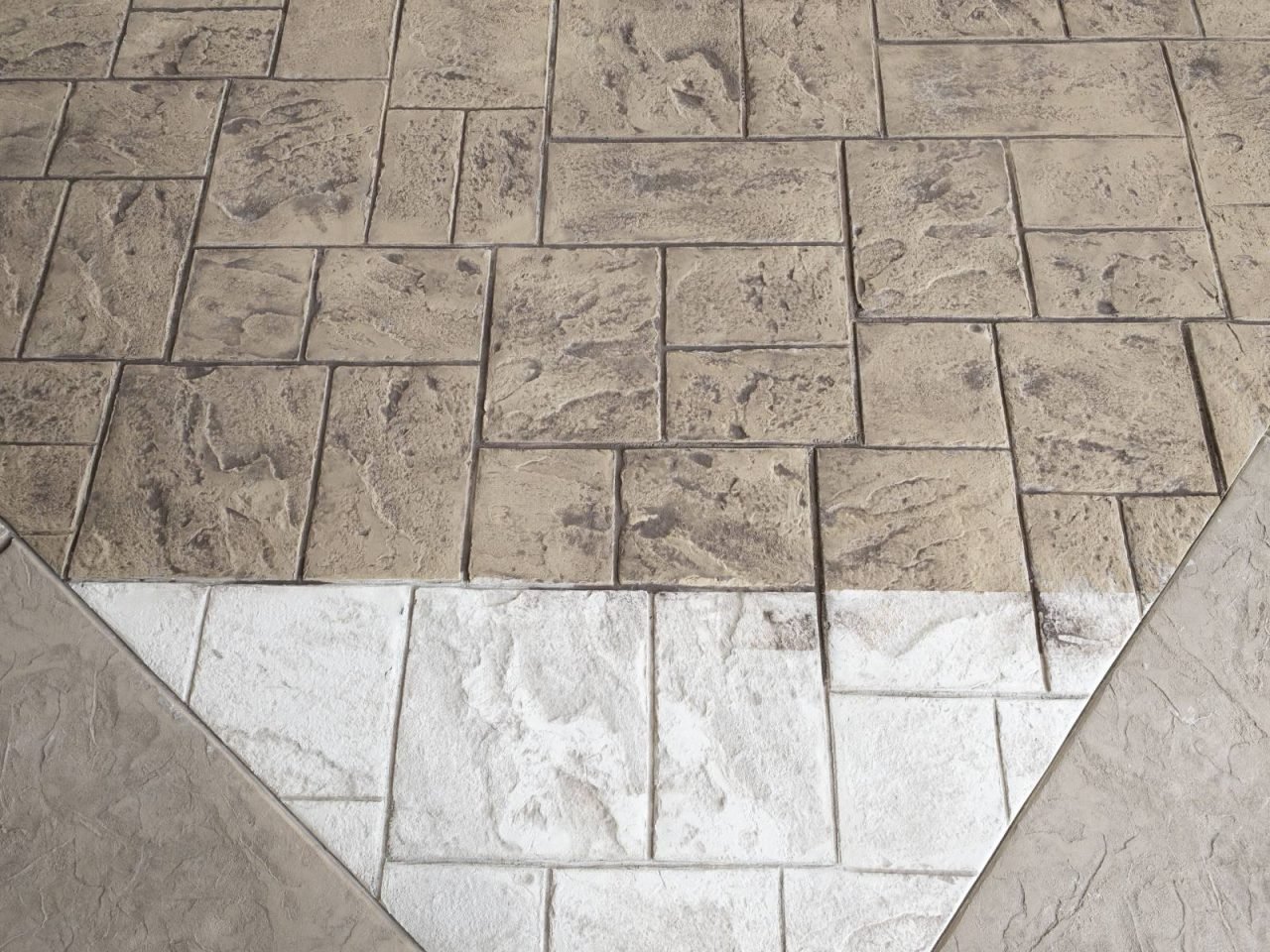
Unlike paint, which eventually chips and peels, Brickform’s Cem-Coat Plus is cement-based, so it bonds much better to the surface. Once it’s on, it’s extremely durable and long lasting. It can go on as a solid color, or get antiqued afterward for a two-tone, aged look. Here’s more on changing your concrete’s color.
There’s a catch with this option:
“As long as there’s still texture there, still outlines, Cem-Coat is going to be a great restoration project. But if it gets to a point where you’re not happy with the texture at all, you have to go a different route.”
— Johnny D’Introno, Solomon Colors trainer
That “different route” means a resurfacing or overlay instead. You need something thicker, with more material, to rebuild what’s been worn away.
Recoloring also works best when your concrete is structurally sound. Cracks and chips won’t disappear underneath a coating. They’ll show through, so get those repaired first.
FREQUENTLY ASKED QUESTIONS
Get cracks repaired before any of these options, especially before a coating like Cem-Coat Plus, which won’t hide damage. Hairline shrinkage cracks aren’t usually a concern, but anything wider than a piece of paper should get patched, since they can let water in and become a bigger problem down the road. It’s best to widen the crack slightly with a saw so patching material can actually get in and bond.
More extensive cracking is worth having a professional assessment. Large cracks or groups of them can be a sign of something going on beneath your slab or improper installation.
Basic cleaning, resealing, and even antiquing are within reach for a confident DIYer with the right equipment. Antiquing is actually pretty forgiving. If you don’t like the color, you can rinse it off and start over, while it’s still wet.
A full recolor is different though. Once a coating like Cem-Coat Plus is applied, uneven application is hard to fix. For this, most homeowners get better results hiring a professional.
Materials alone typically run a few hundred dollars: a 5-gallon pail of sealer is roughly $300, and antiquing agent adds around $30 more. Total project cost also depends on your square footage, which option you choose, and local labor rates.
But it is important to know that generic products from a hardware store aren’t the same as professional-grade Brickform options. Cutting corners there can mean redoing the work sooner than you’d like.
Keep leaves and debris off your stamped concrete with a regular blower pass. Organic matter can cause stains if left sitting. Skip de-icing salt entirely, it’s tough on sealer over time.
For everyday dirt buildup, use Neutra Clean with a soft scrub brush. For stubborn stains like bird droppings, Brickform E-Etch can help lift them. Though a properly sealed surface will resist most staining in the first place.
Most stamped concrete only needs resealing every 3 to 4 years, or sometimes sooner with heavy traffic or a harsh climate. If the sheen starts looking dull between reseals, that doesn’t automatically mean it’s time for a new coat. A light pressure wash with Neutra Clean can often bring the shine back, as long as the sealer is still sound.
Sealing too often does more harm than good. Layering coat after coat builds up over time and leads to bubbling, cloudiness, or a hazy finish instead of the clear, glossy look you want.
Did You Know: A hazy, cloudy, or bubbled sealer with sound material underneath doesn’t always need a full strip-and-reseal. Brickform Sealer Rescue + can restore it without stripping back to bare concrete. It won’t fix peeling or worn-through sealer, but for cloudy sealer that’s still bonded well, it’s worth asking about. More on diagnosing and fixing sealer problems here.
Cloudy or white patches, called efflorescence, are often related to moisture moving through your concrete or salt exposure. Regular cleaning and the right sealer go a long way toward preventing it. If it’s already there, it’s worth having someone assess whether it’s only on the surface or coming from deeper in your slab.